The Tucson chapter holds meetings between September and May each year, with a summer break. We meet on the second Thursday of each month at 7:00 pm. We hold “hybrid” meetings, where we meet both in person and also on Zoom. The live meetings will be in the ENR2 (Environment and Natural Resources 2) building at the University of Arizona, located on 6th street near Park. We meet in Room S215. Parking is available in the 6th St parking garage adjacent to ENR2. A credit card is required to pay for garage parking. If you are not on our mailing list and wish to attend one of our meetings on Zoom, email us at NativePlantsTucson@gmail.com to request the Zoom link. Videos of past meetings can be found on our YouTube channel.
JOIN OUR CHAPTER E-LIST
Join Our Chapter E-list: If you would like to receive announcements about field trips and meetings via e-mail, send a note to the Tucson Chapter email to be added to the list. Stay informed by joining us on Facebook.
Usually, the most up-to-date information about upcoming chapter events can be found on our Facebook page.
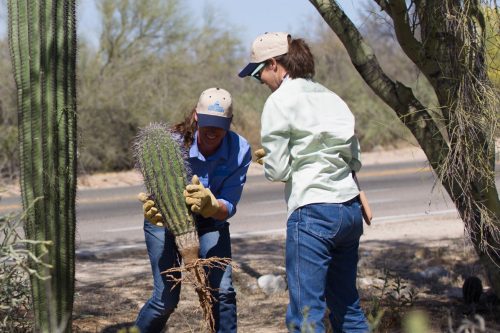
Caring for agave and baby cacti? Consider volunteer opportunities at the Pima County Native Plant Nursery! Located at 5845 N. Camino de la Tierra, the Pima County Native Plant Nursery grows native plants for public projects and is looking for volunteers to help with weeding, watering and propagation. The nursery is open Monday to Friday 7:00am to 3:30 pm. Email Amy for available times/days and details. Plant salvage at Cortaro Farms from Camino Del Oeste to Thornydate prior to road improvement project.
Chapter News
Upcoming Meetings
Posted on Nov 23, 2025
Thursday, December 11, 7:00 PM. Holiday Celebration and Members Showcase
Thursday, January 8, 7:00 PM. Jack Dash: The Southwest Native Plant Primer: 235 Plants for an Earth Friendly Garden
Thursday, February 12, 7:00 PM. Francesca Claverie, Borderlands Restoration Network: Propagation for Restoration
Highlights from Summer 2025
Posted on Nov 23, 2025
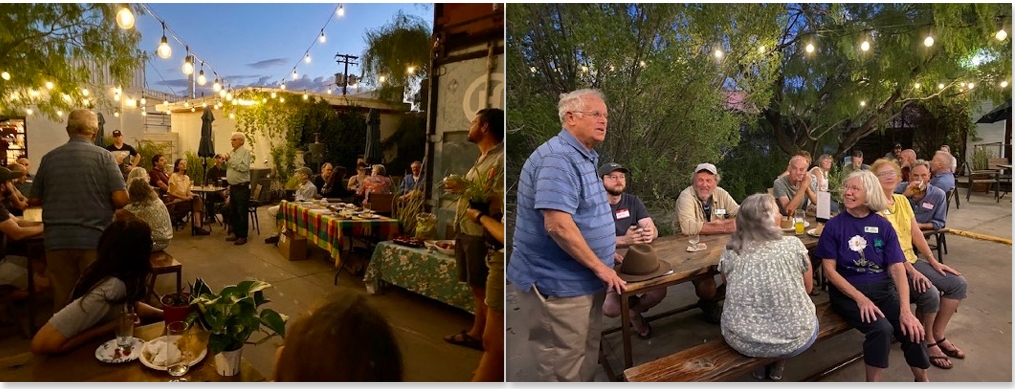
Monsoon Mixer Our annual Monsoon Mixer was postponed until September, in hopes that late rains would bless us. At that time, we gathered at Slow Body Brew, an eclectic pub located in the industrial area near downtown. It was nice to see friends, exchange some cool plants, publications, and summer stories. We were honored to have AZNPS President Doug Ripley join us.
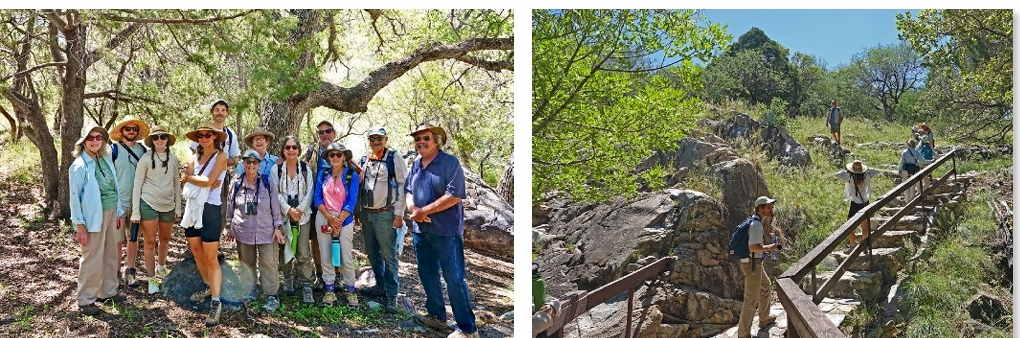
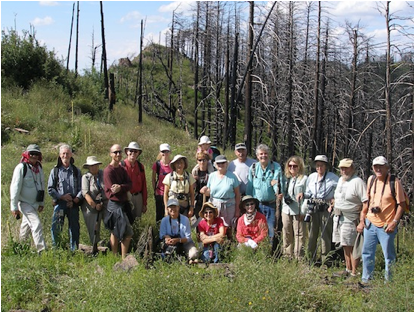
Madera CanyonField Trip At the end of August, we ventured into Madera Canyon in the Santa Rita Mountains with guide extraordinaire Doug Moore. Although the creek was dry due to the ongoing drought, we saw flowering Bouvardia.
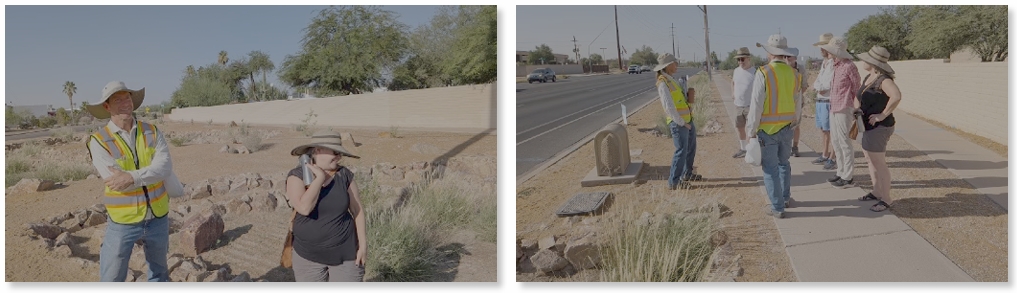
Passive Water Harvesting Field Trips October featured two field trips, one to Honeybee Canyon, in the Tortalita Mountains, and the other in Oro Valley and Oracle, led by Chuck LeFevre of Common Sense Passive Water Harvesting. The tour included touring water harvesting landscapes along roadways, public common areas, and both small and large front yards that employed berms, a rock dam, and other passive-water harvest projects.
Chapter meeting for November 13, 2025
Posted on Nov 09, 2025
The Sonoran Desert: A Global Bee Biodiversity Hotspot, Presented by Tanner Bland, Program Coordinator, Tucson Bee Collective
Thursday, November 13, 2025
Meeting and Presentation, 7pm in person and on Zoom (link below)
U of A campus, Environment and Natural Resources Building (ENR2), Room S210 (NOTE ROOM CHANGE on 2nd floor), 1064 E. Lowell Street, Tucson AZ
The Tucson Bee Collaborative is a partnership between the Arizona-Sonora Desert Museum, University of Arizona Insect Collection, and Pima Community College. The Collaborative is focused on documenting native bee biodiversity, understanding their local conservation status, and involving students in place-based education while participating in cutting-edge molecular research. Our current research efforts focus on sequencing the DNA of every bee species in the Tucson Basin and providing detailed records of their abundance and diversity through time and space.
In this presentation, Tanner will discuss the evolutionary origins, classification, and life histories of some native, solitary bees from the Sonoran Desert region. He will focus on the evolution of bee-plant relationships, using data from his research, which attempts to document how often bees visit certain plants, particularly those of conservation concern.
ABOUT OUR SPEAKER
As the program coordinator for the Tucson Bee Collaborative, Tanner Bland conducts outreach, identifies bee specimens from their collections, and works to expand a DNA barcoding program to include high schools, community colleges, state parks, etc. that help them reach the goal of surveying and monitoring the local bee fauna of the Tucson Basin.
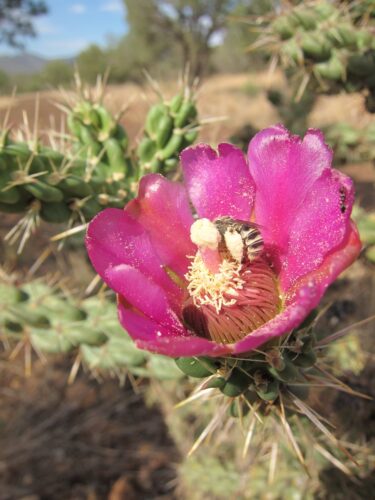
A master’s student in the Entomology department at the University of Arizona, Tanner’s research focuses on using museum bee specimens to understand past and present trends in pollination services performed by native, solitary bees using DNA from pollen grains. Currently, the lab is assessing the diversity of cacti visited by native cactus bees in the genus Diadasia.
Tanner’s other area of expertise is in the ecology, evolution, and phylogenetics of the largest bee genus in North America, Perdita, the fairy bees. They are remarkable in their number of specialized interactions with plants, and Tanner is using them to better understand the evolution of bee diets, how and when specialist bees evolve, and their role in the conservation of rare or imperiled plant species.
ZOOM LINK
As many of you know, we have been having problems getting the Zoom link to work some months. We regret this, but are doing our best. We would be delighted if some tech-savvy member who comes to our meetings in person would like to volunteer to help us with technology for monthly meetings. IF THIS PERSON IS YOU, please email us at nativeplantstucson@gmail.com and identify yourself!
SAVE THE DATE! Holiday Chapter Meeting December 11, 2025
Member’s showcase
We will celebrate the holidays at our December meeting on Thursday, December 11 with hot cider and some holiday treats, so please bring something to share. There will be two short programs with an opportunity to socialize afterward.
Aaron Peretz from the Bureau of Land Management (BLM) will share his experiences in the Ironwood National Monument. Susan Husband will talk about the University of Arizona Herbarium and the experience of being a volunteer.–