Yuma Chapter AZNPS Field Trip March 22, 2023
Posted on Mar 20, 2023

The Yuma Chapter hosts meetings and field trips – generally from October through April.
Meetings are held the third Tuesday of the month at Arizona Western College in the Agriculture and Science Building room AS105.
Field trips are often scheduled the following Saturday, or on other days as decided by the membership and as botanizing opportunities arise.
Announcements of these events and other news updates will be posted via email. If you would like to receive updates, please contact us at our chapter email (yumaaznps@gmail.com) and ask to be put on our list
True to our “Yuman nature,” the Yuma Chapter regularly participates with local organizations whenever the opportunity arises. Many of our members are Master Gardeners and/or members of garden clubs or Yuma Audubon. Through these partnerships we promote cultivating and planting native plants for wildlife habitat and have educated the public about the many values native plants bring to the landscape.
For Yuma Chapter information contact Deidre MacDonald (Dias) at
yumaaznps@gmail.com
Find us on Facebook: @YumaAZNPS or by searching Arizona Native Plant Society Yuma Chapter.

Join Our Chapter E-list: If you would like to receive reminders and announcements about field trips and meetings via email, send a note to yumaaznps@gmail.com to be added to the list.
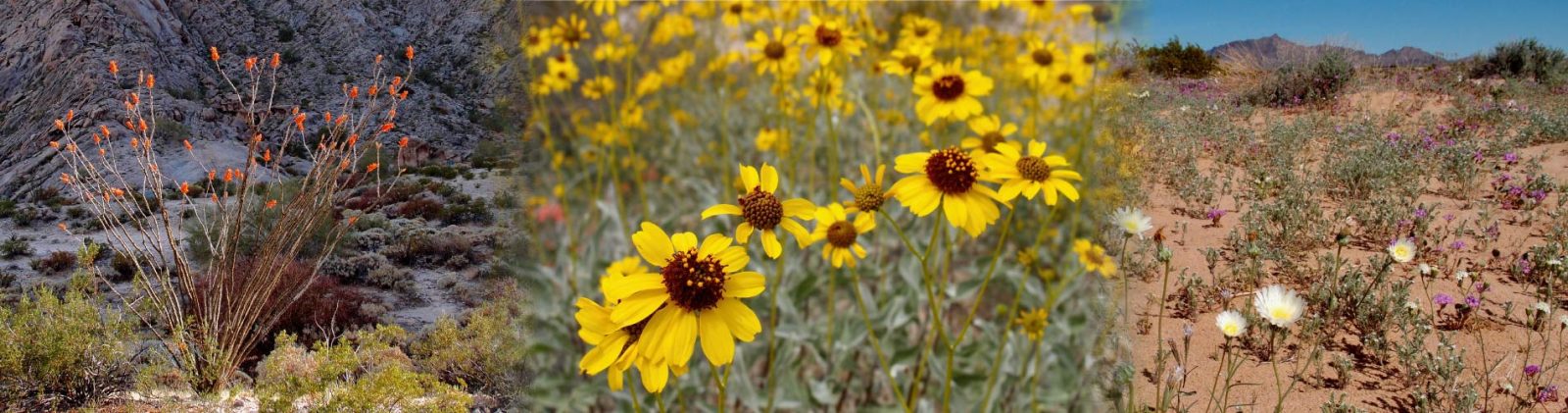
* Photos above by Sue Carnahan.
| Name | Role | Contact |
| Valerie Morrill | President | |
| Karen Reichhardt | Vice President | |
| Tom Fox | Treasurer | |
| Deirdre MacDonald (Dias) | Secretary | yumaaznps@gmail.com |
Want to get involved? We've got just the thing!
During the winter season there are opportunities for members to table annual events such as the home and garden show, the Moody Garden art walk, and the Yuma Birding, Nature and History Festival.
In 2019, University of Arizona Cooperative Extension funded a greenhouse located at the University of Arizona farm. The greenhouse is managed by the Yuma Master Gardeners and a portion of it is used to cultivate natives.
During 2019-2020, members of the Yuma chapter joined the City of Yuma Tree and Shade Masterplan Task Force. The Society is contributing to the task force by providing information to encourage planting native trees.
Yuma Conservation Garden
2520 East 32nd St, Yuma, AZ 85664
Located on the west side of the Yuma County Fairgrounds on the north side of 32nd Street across from the airport. Entrance gate is located just west of the Fairground south entry.
A community treasure of Sonoran Desert experience, environmental education, family events and volunteer opportunities. Open to the public from the first of November through the first of May every Saturday from 9-5 and Sunday noon to 5. Call 928-317-1935 to arrange group entry at other times. An assortment of mature cacti and a desert oasis are unique features of the garden.
Robert J. Moody Demonstration Garden
2200 W 28th St, Yuma, AZ 85364
928-726-3904
Started in 2004 by the Moody Garden Makers, the demonstration garden is open 365 days a year and is free to the public. The garden is a partnership between the University of Arizona and the Moody Garden Makers Garden Club. The purpose of the garden is to educate Yuma residents on gardening in the Southwest. Included in the garden is a native plant and xeriscape section.
Yuma West Wetlands
282 N. 12th Avenue, Yuma, AZ
The 110‐acre West Wetlands Park managed by City of Yuma Parks and Recreation is a jewel and beloved by the citizens of Yuma. The 30 acres of the “lower bench” are restored with a gallery of mature native riparian trees, and an additional 30 acres of the “upper bench” are developed with a lake, picnic ramadas, parking, lighting, and landscaping. A Butterfly and Hummingbird Garden features a mixture of native trees, shrubs and cacti.
Yuma East Wetlands
Accessed by driving to Yuma Territorial Prison, 220 N. Prison Hill Road. From the prison parking lot, drive down the hill to Riverside Park.
The Yuma East Wetlands is considered a model for wetlands restoration in the desert Southwest and is led by a partnership between the Yuma Crossing National Heritage Area, Quechan Indian Tribe, City of Yuma, and Arizona Game and Fish Department.
Restoration activities were initiated in 2004 and nearly 400 acres have been transformed from a trash dump filled with hobo camps into a mosaic of marsh, mesquite, cottonwood, and willows which provide habitat for an array of wildlife species.
A few of the most notable species discovered since the East Wetlands was created include the endangered Ridgway’s Rail (Yuma Clapper Rail) and the presence and successful breeding of the endangered Yellow-Billed Cuckoo.
Posted on Mar 20, 2023
Posted on Sep 05, 2021
Yuma will forgo regular monthly, in-person meetings for the foreseeable future.
Instead, we will focus on outdoor activities—field trips and work projects—and
go virtual for meetings and similar indoor activities. Currently, we anticipate the
following:
September: Everyone keep an eye out for September bloom locations
following the summer monsoons, and we will schedule a hot, muggy but
beautiful field trip to check it out. Please post locations to our Facebook page
(AZ Native Plant Society Yuma Chapter). For example, at this moment, it
seems that the usually shy and somewhat cryptic mammillaria (fishhook cacti)
are ablaze and popping up like Easter eggs out in the Yuma foothills. Now, who
wouldn’t want to see that, no matter the heat? Also on our Facebook page, we
request that everyone post throughout the month of September about recent
plant travels and adventures. This Facebook event will take the place of our
usual October in-person “Show and Tell” program.
For October – December we are planning a suite of outdoor events,
including nursery tours and field trips to refuges and natural areas.
Announcements of these events and other news updates will be posted via
email. Follow us at yumanativeplant@gmail.com by requesting to be on our
email list.
Announcements of these events and other news updates will be posted via
email. Follow us at yumanativeplant@gmail.com by requesting to be on our
email list.
Posted on Mar 27, 2020
Members of the Yuma Chapter are devoting meeting time to the study of plant families represented in the Sonoran Desert flora of our area. Asteraceae, the first family we studied, was presented remotely in December via YouTube by chapter president Valerie Morrill. In February, Erv Barnes followed with a discussion on the puzzling Zygophyllaceae. Later that month a group trekked to the Imperial Sand Dunes in California to find examples of both plant families, spring wildflowers, and to inspect an unusual growth form of creosote bush, Larrea tridentata. We stopped at two places off I-8. The first stop south of Sidewinder Road exit and the second was at the historical Old Plank Road ACEC on BLM west of the Grays Well exit.
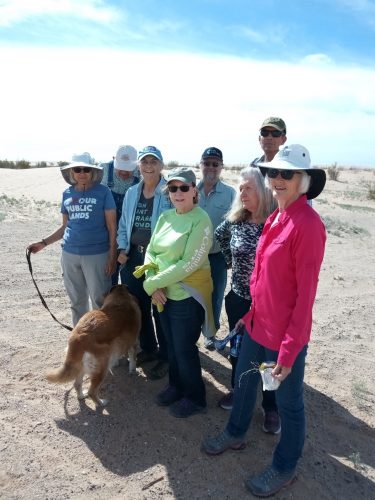
Following is a plant list and photographs recorded by member Linda Johnson.
Trees
Desert willow Chilopsis linearis
Shrubs
Creosote bush Larrea tridentata
Emory Indigo bush Psorothamnus emoryii
Giant Dune Buckwheat Eriogonum deserticola
Joint Fur, Mormon Tea Ephedra (probably trifurca)
Russian thistle Salsola sp.
Annuals and low-growing perennials
Ajo lily Hesperocallis undulata
Bugseed Dicoria canescens
Crinklemat Tiquilia plicata
Cryptantha Cryptantha sp.
Dune primrose Oenothera deltoides ssp. deltoides
Locoweed/milkvetch Astragalus sp.
Sand verbena Abronia villosa
Spanish needles Palofoxia arida
Spectacle pod Dimorphicarpa pinnatifida
Suncup Camissonia sp.
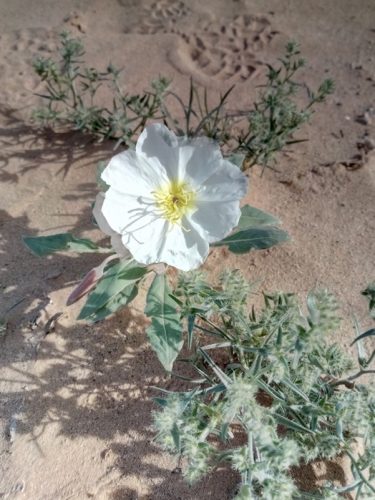
Dune primrose or bird cage primrose
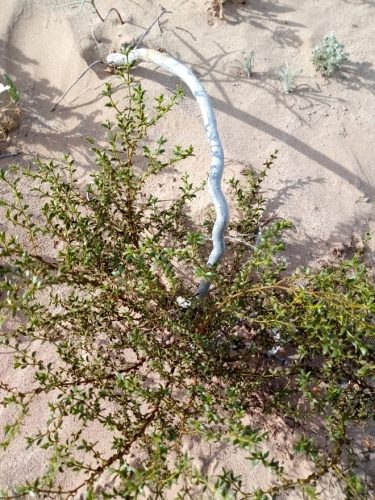
See what your chapter has been up to!


