Phoenix

Chapter Meetings & Events

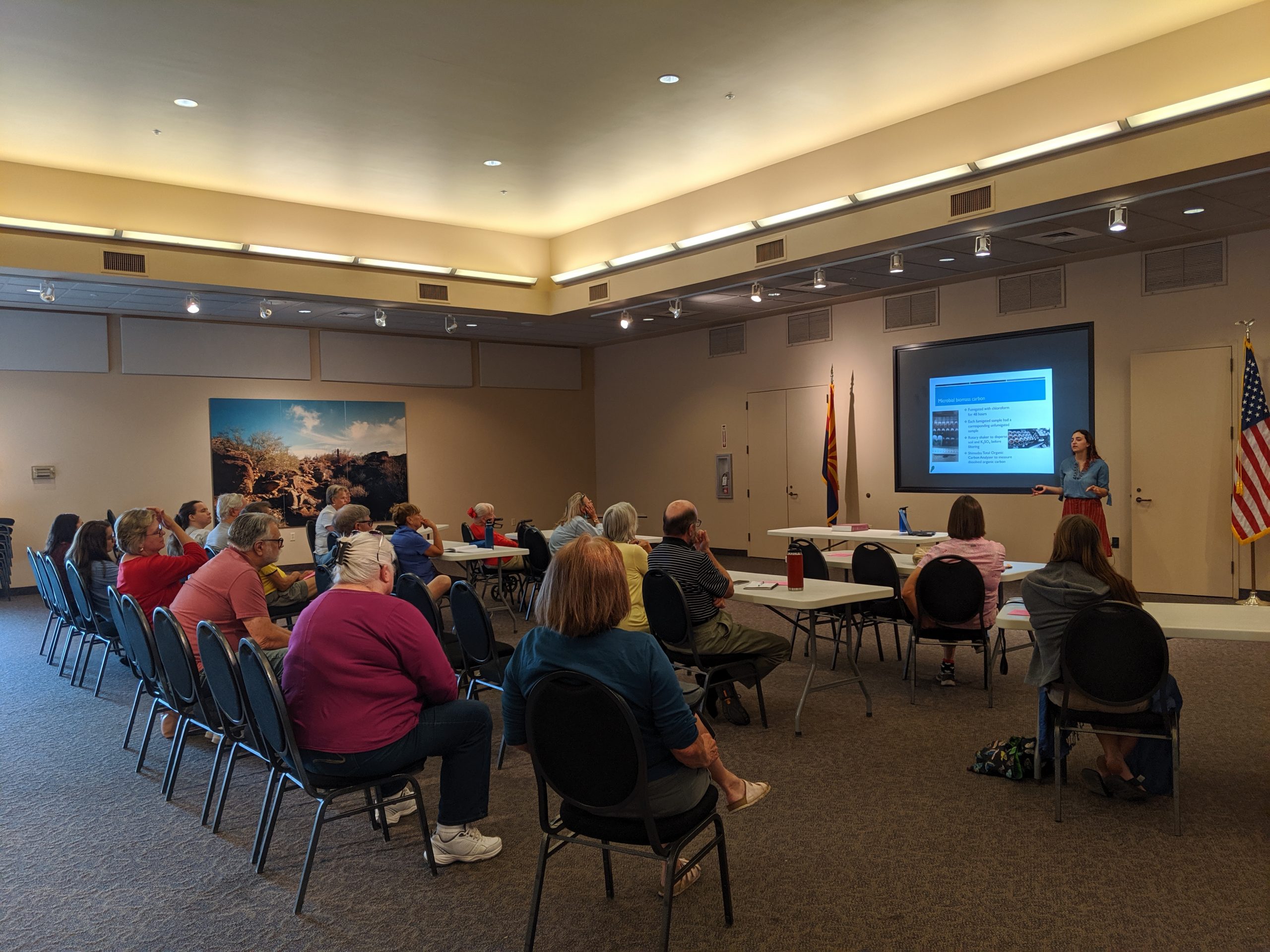
The Phoenix chapter has a monthly virtual members meeting on the first Monday of each month at 7:00 PM. Register in advance once in order to attend any of the meetings virtually. After registering, you will receive a confirmation email containing information about joining the meeting: https://tinyurl.com/2p5v5h8u
Join our email list using this link: https://tinyurl.com/54p6zche
Follow us at facebook.com/aznpsphoenix and Instagram at @aznpsphoenix.
Contact: phoenixaznps@gmail.com

The chapter has a Discord! Members are encouraged to join and collaborate:
https://discord.gg/cMAhVQw6MR

We host events periodically throughout the year. Our events are announced at least 2 weeks in advance to our email list subscribers, and posted here on our Chapter webpage. Our activities are open to Chapter members as well as the general public, unless stated otherwise. Please join our general email list to receive notifications about locally hosted events. If you are interested in volunteering at an event, please join our volunteer email list by filling out this form.

View the AZNPS Events Calendar to learn about upcoming events hosted by all Chapters throughout the state. Recordings of many presentations are available to watch on the AZNPS YouTube page.

Join our virtual community!

To stay up to date on our meetings and other activities, please join our email list or sign up for our volunteer email list to hear about volunteer opportunities. Follow the AZNPS Phoenix Chapter’s Facebook page for more information about local native plants news, research, and events! We also invite you to follow our Chapter on Instagram and use the hashtag #aznativeplants to help us raise awareness of Arizona’s amazing native plants!

If you want to be more involved in the community and event planning, we invite you to join our discord!

Discord Logo Instagram Logo Facebook logo

Seeking native plants to use in landscaping?

View our Chapter’s Plant List for Metro Phoenix to learn which plants are local to our area. It highlights plants that are: native to the Phoenix metro area, beneficial to wildlife, low-water-use, relatively easy to care for, and generally available at local nurseries or seed suppliers. The AZNPS Grow Native resources provide additional information about landscaping with native plants, including planning your garden and pamphlets available to download.

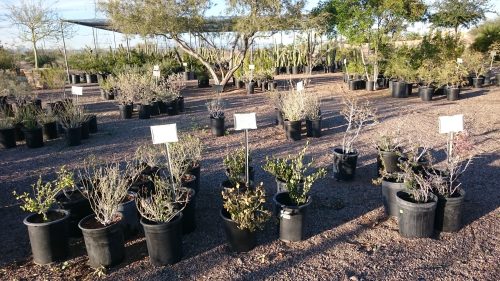
We’ve compiled a list of metro Phoenix nurseries that generally offer a selection of native plants. Some have more variety than others, and inventory changes frequently or may be seasonal. It is best to inquire with a few nurseries by phone or email to determine which one suits your needs.

2026 Seasonal Plant Sales

Several local organizations hold desert plant sale fundraisers in the Spring and Fall. We’ll update this announcement if/when additional native plant sales are scheduled in the metro Phoenix area.

Desert Botanical Garden – Spring Plant Sale: October 22 (members) & October 23 – 26 (general public) – reservations required for entry

Boyce Thompson Arboretum – Spring Plant Sale: March 13 (members) & March 14-29 (general public)

Butterfly Wonderland – Spring Plant Sale: March 13-15

Central Arizona Cactus and Succulent Society Show and Sale: March 27 – 29

Center for Native and Urban Wildlife – Spring Plant Sale: March 26th (10am-2pm) at Scottsdale Community College.

Native Plant & Wildflower Seeds

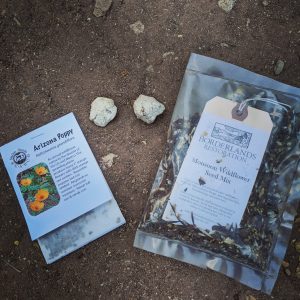
Monsoon season and fall are terrific times to add wildflower seeds to your landscape, assuming it rains! For a wide variety of Arizona native plant seeds, we recommend the following sources:

Maricopa Native Seed Library – The public may obtain up to 3 free seed packets per month. Available at several Maricopa Community Colleges libraries.

Free Tree Programs – SRP offers 2 free trees to home owners using SRP, they have native tree options (must sign up to seminar which is offered twice a year). APS and the city of Phoenix have grants to offer HOAs / communities free trees.

List of Maricopa Seed Libraries – A resource listing where to find free seeds in Maricopa County and the Phoenix Metro Area. Many are hosted in local libraries and mostly offer vegetable and fruit seeds, though sometimes offer native plant seeds as well. Find the seed library closest to you! Many contain additional information on growing plants and links to local community gardens.

Avondale Seed Library Apache Junction Seed Library ASU Seed Library
Chandler Seed Library Glendale Seed Library Maricopa County Seed Library
Mesa Seed Library Peoria Seed Library Phoenix Seed Library
Scottsdale Seed Library Tempe Seed Library

Desert Botanical Garden – Purchase seeds online or in person at their Garden Shop.

Native Seeds/SEARCH – Purchase seeds online from their conservation farm in southern Arizona.

Borderlands Restoration Network – Purchase seeds online or visit their nursery in Patagonia.If you feel there’s a local nursery, native plant fundraiser, or seed supplier we should add to our list, please let us know!

Local nature walks and educational events

Many local organizations host free or low-cost seasonal nature walks, interpretive hikes, gardening classes, and educational activities with a focus on native plants & habitats. Learn more by clicking on the links below.

– McDowell Sonoran Conservancy – Maricopa County Parks & Recreation
– Desert Foothills Land Trust – Lost Dutchman State Park
– Skyline Regional Park – Sierra Club – Outings
– Phoenix Parks & Recreation – Boyce Thompson Arboretum
– Liberty Wildlife – Free nature walks Center for Native & Urban Wildlife
Water Use it Wisely Desert Botanical Garden
Desert Institute of Gardening Maricopa Native Seed Library
Be Outdoors Arizona


Chapter Leadership

Name Role Contact
Daniela Howe President phoenixaznps@gmail.com or imdanielahowe@gmail.com
Mark Cirillo Communications Director phoenixaznps@gmail.com
Kevin Brown Treasurer phoenixaznps@gmail.com
Kathleen McCoy Secretary phoenixaznps@gmail.com


Volunteering Opportunities

Want to get involved? We've got just the thing!

Conservation Volunteer Opportunities

If you are interested in volunteer activities related to restoration, invasive species control, gardening, conservation, or scientific research, we recommend contacting the following organizations.

Citizen Science Opportunities

These are citizen science and community science projects you can participate in on your own at home, during a walk in your neighborhood, or while visiting Arizona’s public lands.

iNaturalist

Contribute photos and information about your wildlife sightings to have them identified by other iNaturalist users. “Research grade” observations also contribute to scientific research.

Saguaro Census

Help the Desert Botanical Garden document saguaro cactus in the urban areas of metro Phoenix and take notes on their overall health. You may also submit reports of dead saguaros.

Desert Refuge – Monarchs and Milkweeds in Arizona

Document the presence of monarchs and the seasonal changes of milkweed at a location of your choosing.

Nature’s Notebook

Document the seasonal changes in plants or animals near your home by becoming a USA – National Phenology Network observer.

Budburst

Observe plants as part of this national program to help scientist understand how plants are responding to long-term changes in climate. Or, join their Milkweeds and Monarchs project which is studying whether monarch butterflies prefer to lay eggs on non-flowering milkweed plants.

Libraries as Hubs for Citizen Science

Visit a participating library that loans out citizen science tools and supplies.

Buffelgrass Green-up

Contribute invasive buffelgrass observations to the USA – National Phenology Network’s Buffelgrass Green-Up phenophase map.

Southwest Monarch Study

Monarchs need milkweed and nectar plants, so hopefully you have these growing in your yard or neighborhood! Join this monarch “tagging” project to help document Western monarch migration.

Desert Defenders

A special initiative in metro Phoenix to identify and map invasive plants. There is also a special project dedicated to locating stinknet (Oncosiphon piluliferum/pilulifer).

Wild Spotter

While visiting National Forests and other wild lands, keep an eye out for invasive plants.

Tamarisk Beetle Monitoring

Help RiversEdge West track the spread of tamarisk beetles (Diorhabda spp.) across the western United States and Mexico. Data is used for an annual distribution map that notes presence and absence of tamarisk beetles.

Western Monarch Milkweed Mapper

If you see milkweed plants or monarch butterflies, eggs, or caterpillars while outdoors, take a photo and submit your sighting to this regional project.

GLOBE Observer

Participate in their Land Cover project to help scientists create better maps. Or, join the Trees project by taking height and circumference measurements.

eBird

Native plants attract a variety of birds. Report the type of birds you see in your yard, neighborhood, or local park.

Bumble Bee Watch

Native flowering plants are essential for bumble bees. Help scientists track their populations by submitting photos of the ones you see.

Rainlog.org

If you have a rain gauge at home (or decide to purchase one), join this Arizona rainfall monitoring network to submit your daily rainfall totals.

Zooniverse

Select from a variety of online projects to contribute to real academic research from your own computer.

DigiVol

Access digitized natural history data online to help transcribe and decipher field notebooks, photographs, museum labels, and data sheets from around the world.

Chapter News

Announcing Plant Press Arizona!

Posted on Aug 20, 2021

The Society’s bi-annual publication has a new name! To distinguish itself as a source for local botanical information, The Plant Press is now known as Plant Press Arizona.

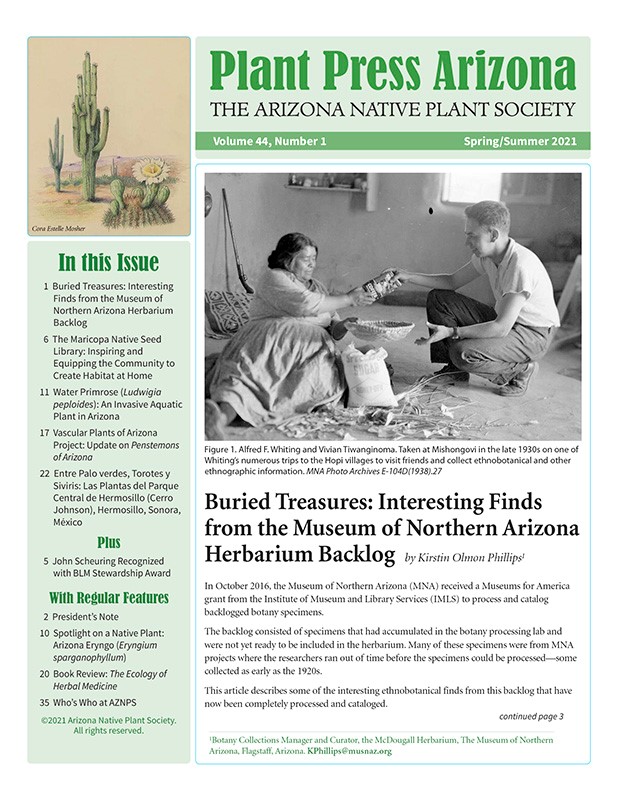
The latest issue is available to view and download for free from our website. Read about herbarium buried treasures, penstemons of Arizona, the Maricopa Native Seed Library, and native plants of Hermosillo (with articles in Spanish & English).

Cover of the Spring/Summer 2021 edition of Plant Press Arizona.

To view previous issues, please see the Plant Press archive on our website.

Summer Happenings

Posted on May 31, 2021

The Summer 2021 edition of Happenings, the Arizona Native Plant Society’s quarterly newsletter, is now available. Take a look for information from around the state about upcoming virtual meetings, our fountain grass awareness campaign, the 2021 Botany Conference, and a recap of recent activities.

Plant Profile: Desert Ironwood

Posted on May 31, 2021

Guardian of the Desert

By Kathleen M. McCoy, Master Naturalist, AZNPS Phoenix Chapter Member

Leer en español

What thorny, long lived, slow-growing giant can nurture a wide range of plants, provide roosts for birds, and produce protein-rich seeds for animals? The Desert ironwood (Olneya tesota) can do all the above and more!

A member of the Leguminosae family, Desert ironwood’s natural boundaries correspond closely with those of the Sonoran Desert. Additional names for this endemic tree within the U.S./Mexico borderlands include Ironwood, Palo Fierro, and Palo de Hierro, and Tèsota.

Commonly found in washes and hillside drainages, Ironwoods thrive in warm areas below 3,000 feet. The Ironwood Forest National Monument, located 25 miles northwest of Tucson, was established in June 2000 and provides protection for one of the richest areas of Ironwood trees.

Ironwood trees strongly influence the distribution and quantity of hundreds of wildlife species by functioning as a “nurse plant” and a “keystone species.” Canopies of mature trees provide microenvironments advantageous to understory plants, with winter temperatures several degrees warmer than open areas. In addition to protecting seeds and seedlings from extreme cold, Ironwoods also provide safety from radiation and predation.

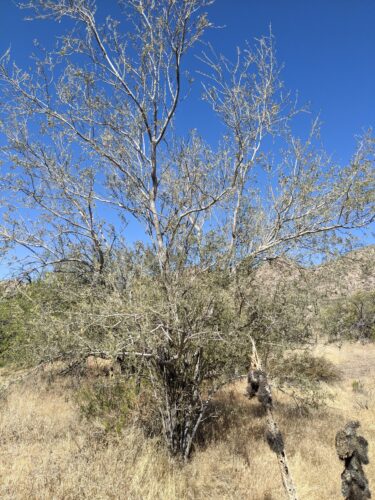
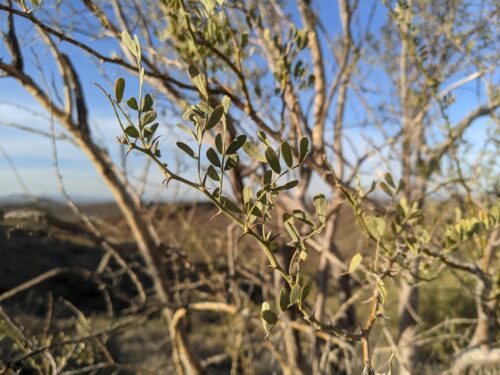
The perennial Ironwood can remain as a many stemmed, 6-feet high spiny shrub, or erect and spreading with a low canopy with a thick trunk reaching 30 feet or more. This semi-deciduous native tree is covered with grayish-green leaves that endlessly drop and regrow throughout the year. At the base of each leaf are excruciatingly sharp, slightly curved paired spines. The piercing thorns and low canopy protect small reptiles and desert mammals from larger prey and provide forage, cover, and nesting sites.

As one of the tallest trees in the desert scrub, with a potential life span of 800 years, its canopy is used by nearly 150 bird species. Local and migrating birds, such as endangered cactus ferruginous pygmy-owls, build nests in Ironwoods. Hawks and owls often use bare branches as perches and roosts.

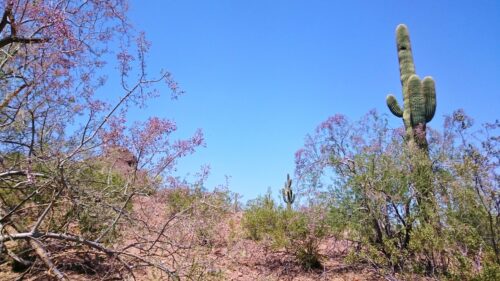
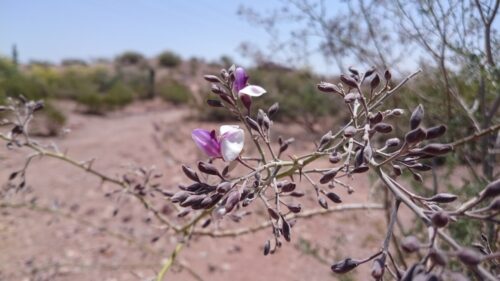
In April and May, small pale lavender or purple flowers blanket the tree, but only for about two weeks. Ironwood flowers and fruit may occur in most years, but are abundant only four years per decade. Native bees are commonly attracted to the flowers. After pollination, ironwoods produce slightly curved, knobby pods containing up to eight shiny dark brown hard-shelled seeds. These are an important food source for native fauna in early summer.

The Ironwood is also beneficial to humans and was widely used as food by the Cahuilla, Mohave, Papago, Pima, and Seri indigenous people. The peanut or soy flavored seeds were eaten either raw, dry roasted, or ground for flour. Roasted seeds have been used as a substitute for coffee beans.

The tree’s wood has social and economic impact as well. The name “Ironwood” refers to the hard, heavy heartwood so dense it cannot float. The trunk is highly resistant to rotting, and may remain intact up to 1600 years. Wood was used for fuel, as well as for making various kinds of tools and implements like digging sticks and shovels. Ironwood also added to the aesthetic of daily life by providing wood for weaving frames, musical instruments, and the beautiful carvings of the Seri.

Photo credits: Lisa Rivera

Sources:

Arizona-Sonora Desert Museum. (n.d.). Biological survey of Ironwood Forest National Monument. https://www.desertmuseum.org/programs/ifnm_ironwoodtree.php

Bureau of Land Management. (2021). Ironwood Forest National Monument. https://www.blm.gov/visit/ironwood

Marshall, C. (2018). Why is ironwood so heavy? Woodworkers Journal. https://www.woodworkersjournal.com/why-is-ironwood-so-heavy

Rymer, C. (2003). The ironwood: stately sanctuary in the Sonoran Desert. Master Gardener Journal. https://cals.arizona.edu/maricopa/garden/html/pubs/0803/ironwood.html#

Southwest Desert Flora. (2017). Olneya tesota, Desert ironwood. http://southwestdesertflora.com/WebsiteFolders/All_Species/Fabaceae/Olneya%20tesota,%20Desert%20Ironwood.html
Gallery

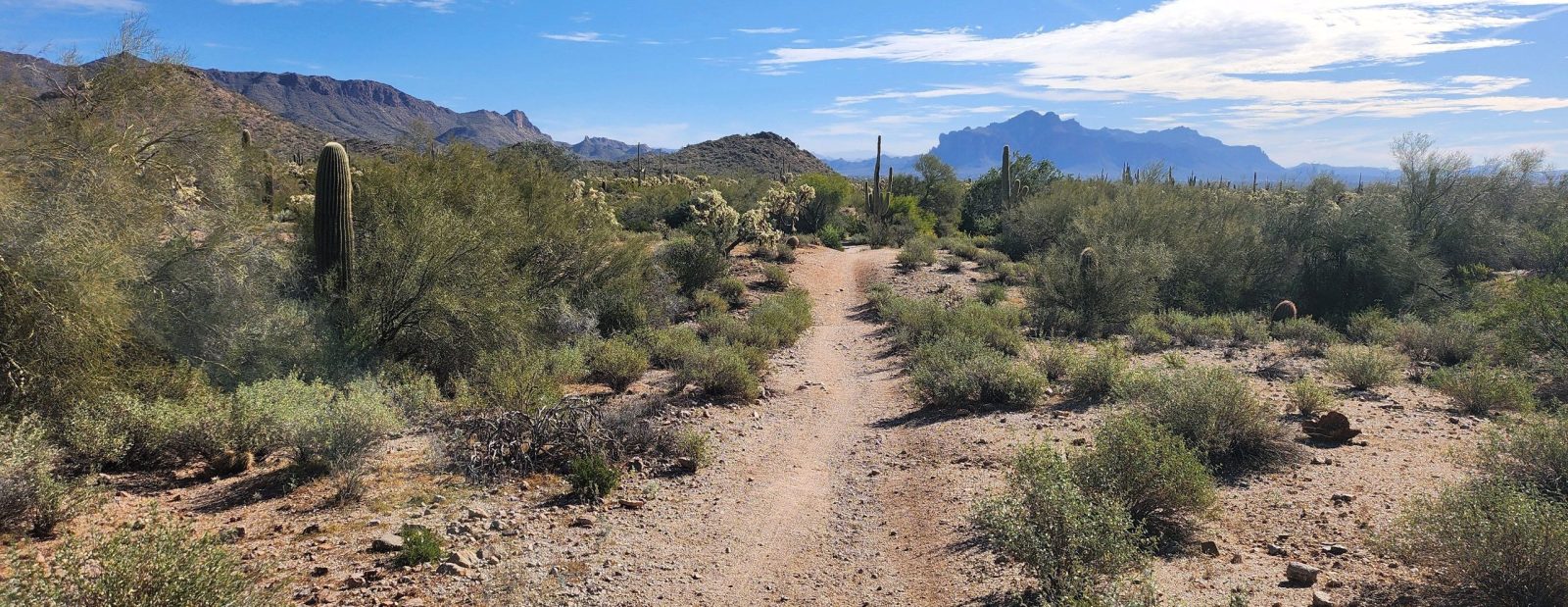
See what your chapter has been up to!